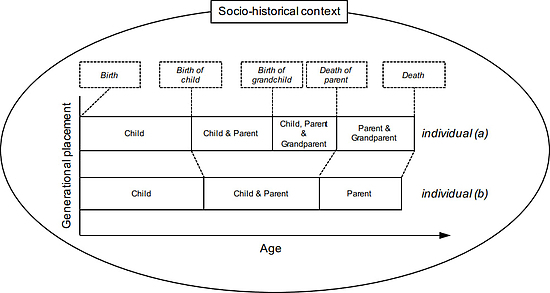
The presence or absence of ascendants and descendants in the family network of individuals determines their generational placement: i.e., whether they occupy the role of a child, a parent, and/or a grandparent. As people age, they transition through different generational placements as a result of births and deaths in the intergenerational family system, which is a fundamental source of social support. These family transitions can occur at various ages (timing) and in distinct orderings, leading to a variety of generational placement trajectories.
The first aim of the project is to identify typical patterns of generational placement trajectories and to investigate the prevalence of these patterns over time and in different European contexts. Some generational placement trajectories are more common than others because sociohistorical contexts, which are characterized by their specific institutions and societal norms, favor certain life courses. Previous research has investigated specific family transitions separately or accounted for only two generations at a time. Thus, little is known about how the structure of the intergenerational family system, or the individual’s position within it, varies across and between individual life courses. This project presents a novel analytical approach to the study of intergenerational family systems by applying methods of sequence and cluster analysis. The project provides a more comprehensive description of the family structure as a process, i.e., a sequence of multiple events. It examines the variations in family trajectories over age and between individuals, and it highlights the micro-level consequences of the macro fertility and mortality trends described by the second demographic transition framework.
The second aim is to investigate the potential consequences of typical generational placement trajectories for individuals’ well-being and health later in life, as well as for their wealth accumulation over the life course. Kinship structures may be important determinants of individual-level outcomes because generational placements are accompanied by socially conditioned normative behavioral expectations, such as (un)salutary health or (non)risky financial investment behaviors. Previous research has demonstrated that single family transitions (i.e., becoming a grandparent) and positions (i.e., being a grandparent) are associated with different life course outcomes, such as overall well-being, physical health, or homeownership. This project extends existing research by examining how multiple family transitions and positions, and their timing and ordering, are mutually associated with individual outcomes. The project offers a broader context for this existing research by providing a thorough description of the family system and its associations with individual outcomes.
The project’s results can be used to identify structurally vulnerable groups and guide policy aimed at preventing the accumulation of disadvantage and its transmission across generations. Moreover, they can inform theoretical advances in our understanding of how multiple family transitions interact and contribute to social inequality.
Collaborators
- Bettina Maria Hünteler
- Karsten Hank, University of Cologne, Institute of Sociology and Social Psychology, Germany
- Thomas Leopold, University of Cologne, Institute of Sociology and Social Psychology, Germany
- Theresa Nutz, Leibniz Institute for the Social Sciences, GESIS, Mannheim, Germany
- Jonathan Wörn, Norwegian Institute of Public Health, Centre for Fertility and Health, Oslo, Norway